
Managed IT Knowledge Hub · Article 1 of 5 · 8 min read
If you've been comparing IT support options in Singapore, you've met the term Managed Service Provider more than once. Here's what a Managed Service Provider actually is, what one does day to day, and how to tell whether your business needs one.
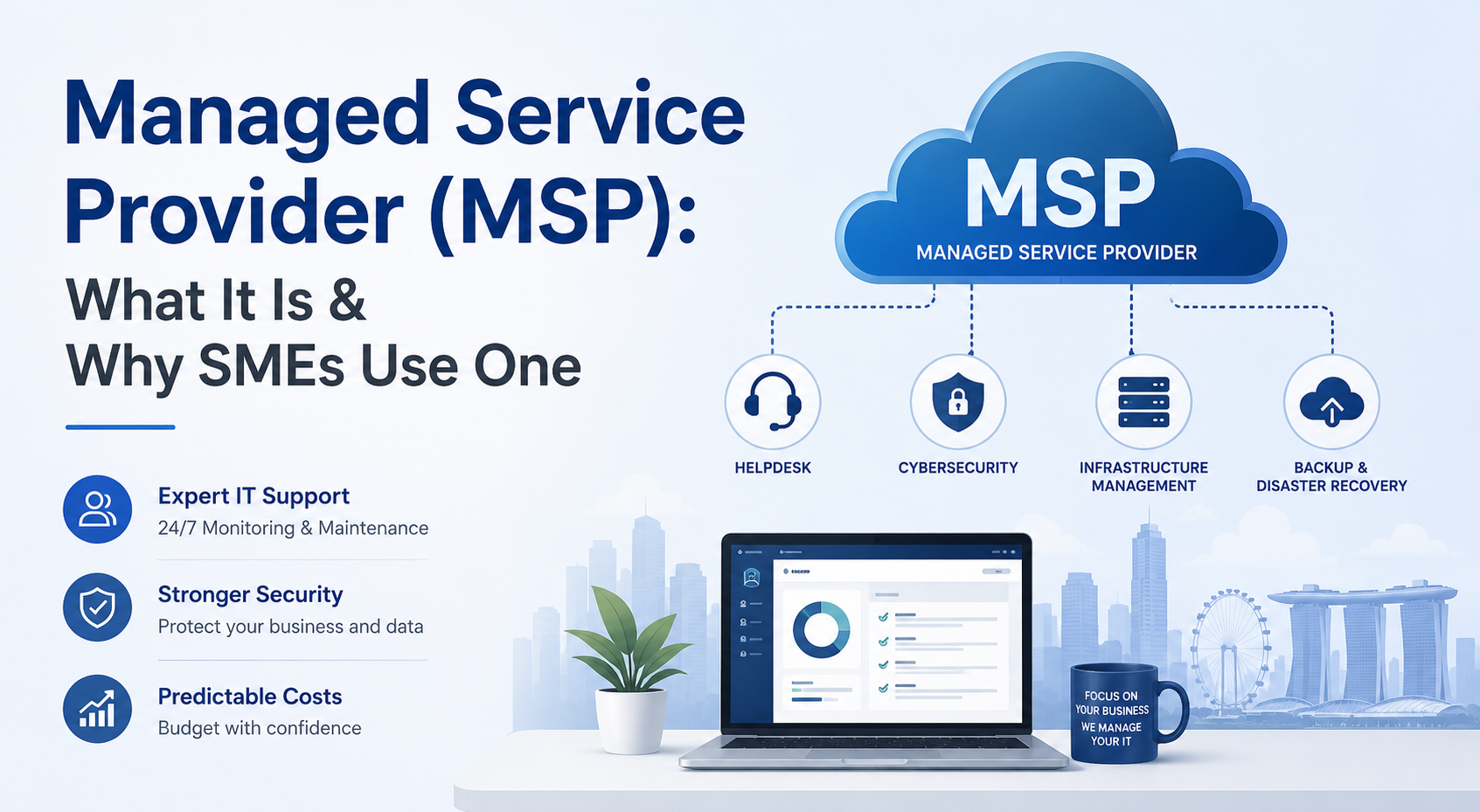
A Managed Service Provider (MSP) is a third-party technology partner that manages, monitors and supports a company's IT environment on an ongoing basis, for a fixed monthly fee. Rather than waiting for something to break, a Managed Service Provider works to prevent problems: keeping systems patched, watching for security threats, backing up data and giving staff a helpdesk to call when they're stuck.
For a lot of small and medium-sized businesses here, the maths of an internal IT team just doesn't work. One good engineer is expensive. A team covering networking, cybersecurity, cloud and infrastructure is out of reach entirely. A Managed Service Provider is how SMEs get that breadth of expertise anyway, without carrying the headcount.
The umbrella term for what an MSP delivers is managed IT services. In practice that usually means IT helpdesk support, network monitoring, cybersecurity protection, cloud and Microsoft 365 management, backup, endpoint security and general infrastructure upkeep.
How the Managed Service Provider Model Works
The easiest way to understand a Managed Service Provider is as a loop that never stops running. Your systems get monitored constantly, small issues get fixed before they become big ones, your team gets support when they need it, and you get a report showing what happened. Then it repeats.

The managed IT cycle: monitor, prevent, support, report.
What Does a Managed Service Provider Actually Do?
The scope varies between providers, but a proper Managed Service Provider in Singapore will cover most or all of six areas: proactive monitoring and maintenance, IT helpdesk support, cybersecurity management, cloud and Microsoft 365 administration, backup and disaster recovery, and infrastructure management. The cards below break each one down.
Proactive Monitoring & Maintenance
Remote monitoring and management (RMM) tools watch your servers, network and devices around the clock. Updates and patches go out automatically, and warning signs get dealt with before your staff ever see them.
IT Helpdesk & Technical Support
When someone can't log in, email stops syncing or a laptop misbehaves, they call the helpdesk instead of waiting for "the IT guy" to be free. Issues get logged, fixed and escalated to vendors where needed.
Cybersecurity Management
Ransomware, phishing and business email compromise now target SMEs deliberately. A Managed Service Provider layers the defences most small firms can't run alone, and keeps watching them.
Cloud & Microsoft 365 Management
Most Singapore SMEs live in Microsoft 365. Someone still has to manage the accounts, lock down access, protect the mailboxes and back up the data. That someone is usually the MSP.
Backup & Disaster Recovery
Hardware fails. Files get deleted. Ransomware happens. What decides whether that's an inconvenience or a crisis is whether your backups exist, and whether anyone has verified they actually restore.
Infrastructure Management
Physical servers, firewalls, switches, office Wi-Fi. If you run infrastructure on-site, the MSP maintains it: configuration, firmware, documentation and lifecycle planning included.
Managed Service Provider vs Traditional IT Support
Most businesses know the traditional break-fix model well: something goes wrong, you call an IT company, they fix it, you pay. A Managed Service Provider works on the opposite logic. The comparison below sums it up; we've written a full break-fix vs managed IT comparison if you want the long version.
| Traditional IT Support | Managed Service Provider |
|---|---|
| Reactive: called in after a problem | Proactive: monitoring and prevention |
| Fixes issues after failure | Flags risks before failure |
| Unpredictable, per-incident costs | Fixed monthly fee |
| No ongoing visibility | Continuous monitoring and reporting |
| Focused on repairs | Focused on reliability and improvement |
The short version: an IT company fixes technology. A Managed Service Provider manages it, so it needs fixing far less often.
Why Singapore Businesses Are Switching to Managed IT
Access to real expertise. A full internal team covering networking, security, cloud and infrastructure is beyond most SME budgets. An MSP gives you specialists across all of it.
Stronger cybersecurity. Threats aimed at SMEs are rising, and agencies like Singapore's Cyber Security Agency keep urging smaller firms to lift their cyber hygiene. A Managed Service Provider delivers continuous monitoring, layered security controls and tested backups, without you hiring a dedicated security team.
Less downtime. Downtime hits productivity and revenue directly. Proactive maintenance catches most issues before anyone stops working.
Predictable costs. One known monthly number instead of surprise repair bills. IT becomes something you can actually budget.
Who Needs a Managed Service Provider?
Not every business does. But an MSP is usually the right call if several of these sound familiar:
- Your daily operations depend heavily on technology
- You don't have a dedicated internal IT team
- You're worried about ransomware and phishing
- Your IT setup is getting more complex as you grow
- You want IT costs you can predict and budget
- You need guidance on cloud and infrastructure decisions
For most Singapore SMEs, that's enterprise-level IT capability without building the department, which is exactly the trade a Managed Service Provider offers.
How to Choose the Right Managed Service Provider in Singapore
If you're evaluating providers, these four checks will filter the field quickly.
Experience and expertise
Ask how long they've operated in Singapore, which industries they support, and what certifications and vendor partnerships they hold. References matter more than brochures.
Service coverage
A reliable MSP covers helpdesk, infrastructure, cybersecurity, backup, cloud and monitoring under one roof. Gaps in coverage become your problem later.
A genuinely proactive approach
Ask exactly what they monitor, how patching works, how often security is reviewed and what reporting you'll receive. "We'll respond quickly" is not proactive.
Understanding of your business
Technology should serve your operations, not complicate them. A good MSP asks about your business before recommending anything.
How iWV Delivers Managed IT Services in Singapore
iWV has been operating as a Managed Service Provider for Singapore businesses since 1998. Our managed IT offering is called ServicePAQ, and it covers the full scope described above: IT helpdesk, endpoint management, cybersecurity protection, network management, backup and recovery, and cloud and Microsoft 365 support.
The whole model is built around one idea: moving businesses from reactive troubleshooting to an IT environment that's monitored, secured and quietly maintained in the background. If you're curious how the packages fit together, we've broken that down in How ServicePAQ Works.
Frequently Asked Questions About Managed Service Providers
What does MSP stand for?
MSP stands for Managed Service Provider: a company that manages and supports IT systems, infrastructure, cybersecurity and technology services for businesses on an ongoing basis.
What is the difference between a Managed Service Provider and an IT company?
A Managed Service Provider delivers continuous, proactive IT management under a monthly agreement. A traditional IT company typically works project by project, or gets called in when something has already broken.
How much does a Managed Service Provider cost in Singapore?
Most MSPs price per device or per user, monthly. The total depends on how many users and devices you have, your security requirements and the level of support you need. ServicePAQ, for example, starts with a flat per-endpoint rate covering monitoring, security and backup.
Are managed IT services suitable for SMEs?
Yes. SMEs are the main users of managed IT services, because a Managed Service Provider gives them professional IT expertise, cybersecurity protection and helpdesk support without hiring an internal IT department.
Does a Managed Service Provider replace internal IT staff?
Not necessarily. Many businesses run a co-managed setup: the internal team keeps ownership of business applications and strategy, while the MSP handles monitoring, security, maintenance and after-hours coverage.
Final Thoughts
A Managed Service Provider turns IT from a thing that interrupts your week into a thing that quietly works. For Singapore SMEs, that means expert support, better security, predictable costs and a lot fewer fires to fight.
The right MSP lets you focus on the business while someone else worries about the servers. That's the whole point.
Want to Know What an MSP Would Change for Your Business?
Our team will review your current environment and show you exactly where managed IT would reduce your risk and your downtime. No guesswork, no overselling.
Explore Managed IT Services Singapore →Free assessment · No lock-in for the first 3 months · Onboard within the week
ICONZ-Webvisions · Managed IT & Cloud Services · Singapore · iwv.works