
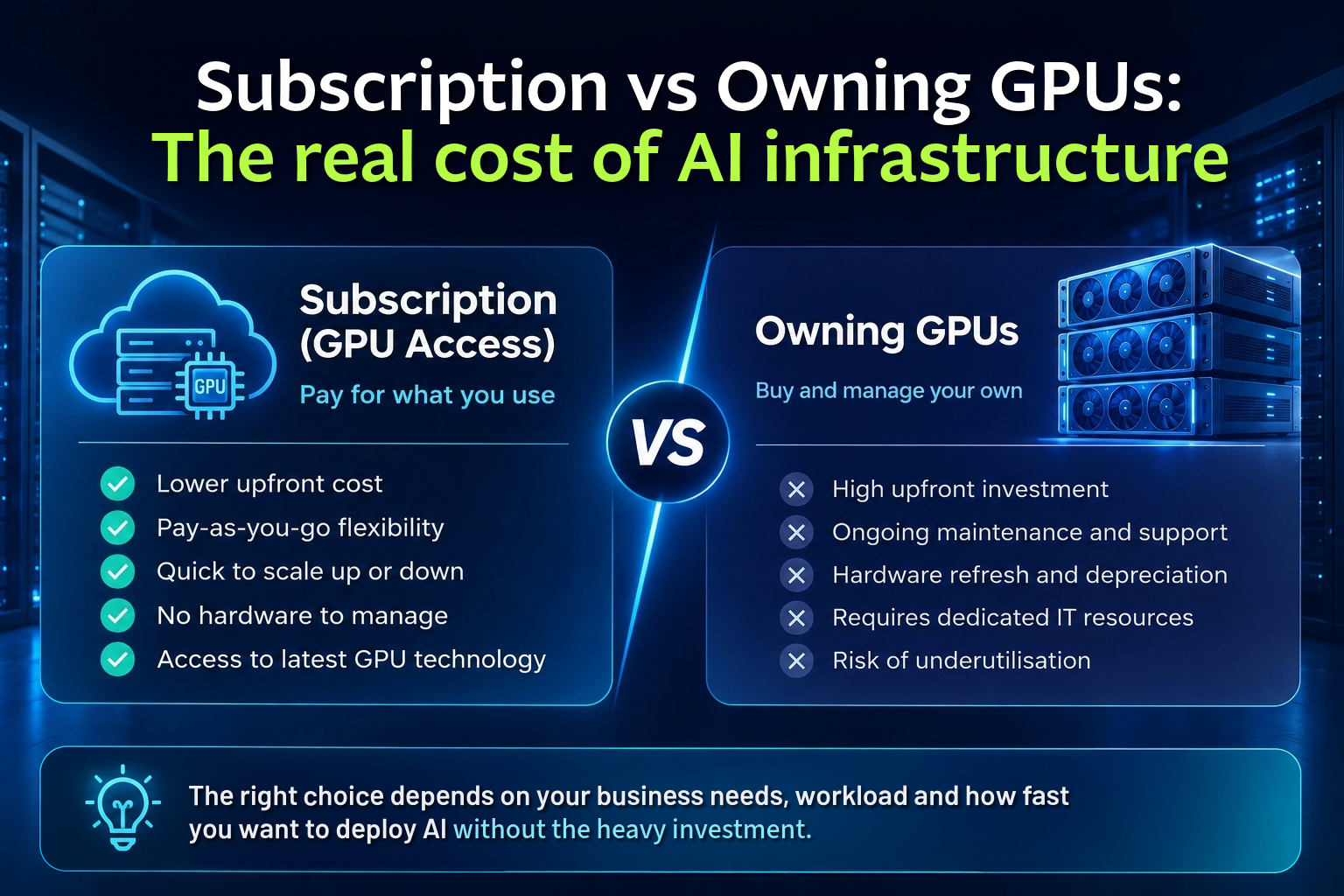
Subscription vs owning GPUs: the real cost of AI infrastructure
The price of the GPU is rarely the full cost of running AI infrastructure. Organisations also need to account for power, cooling, networking, storage, software, maintenance and operational expertise. A managed approach brings these requirements together into a more predictable cost structure.
- GPU cost is only part of the investment. Power, cooling, networking, space, expertise and depreciation all contribute to the total cost of AI infrastructure.
- Managed pricing can improve cost predictability. It reduces exposure to hardware depreciation, unused capacity and variable usage costs.
- Managed AI infrastructure can accelerate time-to-value. Businesses can deploy AI faster, avoid heavy upfront investment and scale capacity as demand grows, helping teams focus resources on AI use cases and business outcomes rather than infrastructure management.
When organisations evaluate private AI infrastructure, the comparison often starts with GPU purchase costs versus a monthly managed fee. But hardware ownership involves much more than the initial investment. Power, cooling, networking, maintenance, security and technical resources all become part of the ongoing operating cost.
| Own the hardware | Public per-token (ChatGPT, Gemini, Claude) | Managed subscription (iWV) | |
|---|---|---|---|
| Upfront capital | High hardware and setup costs | None, usage based | None |
| Cost predictability | Fixed with future refresh costs | Variable and usage dependent | Predictable monthly cost |
| Depreciation risk | Your responsibility | None | None |
| Idle capacity | You pay for unused capacity | No unused hardware cost | Capacity can be adjusted to your workload |
| Time to first workload | Typically months | Usually immediate | Same day to several working days, depending on setup |
| Data control | Full control | More limited control | Greater control within the managed environment |
The Full Cost of AI Infrastructure Ownership
Running your own AI infrastructure involves more than purchasing GPU servers. The total cost includes the infrastructure and expertise required to operate it over time:
- GPU servers that depreciate as newer generations of hardware become available.
- Networking and storage designed to support high performance AI workloads
- Power and cooling, required to operate high density GPU infrastructure.
- Data centre space, including the cost of hosting, securing and maintaining the environment.
- Specialist expertise to architect, monitor, optimise, maintain and support the infrastructure.
A GPU is only part of the total cost. Power, cooling, expertise, maintenance and depreciation continue for as long as the infrastructure is in operation.
Why Managed Pricing Works Differently
A managed pricing model brings infrastructure, operations and support into a predictable monthly cost. This can change the economics of running private AI in three important ways:
- Predictable costs. A fixed monthly model makes AI infrastructure costs easier to forecast and budget compared with usage based pricing that increases as demand grows.
- No hardware depreciation. The provider manages hardware replacement and infrastructure lifecycle, so your organisation does not carry the depreciation risk.
- Less unused capacity. You avoid the cost of owning and maintaining GPU capacity that may sit idle during periods of lower demand.
A Worked Example: What the Same Capability Costs to Start
The numbers make the difference clear. An 8 GPU NVIDIA H200 server can cost around S$470,000 upfront, before power, cooling, data centre space and operational costs. A single H200 can cost S$40,000 to S$51,000, and still requires a server platform, networking and supporting infrastructure. For businesses looking at their AI infrastructure options, the comparison is between owning the hardware, using managed AI infrastructure or relying on public AI platforms such as ChatGPT, Claude and Gemini. Here is how the three options compare in dollars:
| Buy your own H200 server | Pay a public AI platform per use (ChatGPT, Gemini, Claude) | iWV managed subscription | |
|---|---|---|---|
| Upfront cost | ~S$470,000 for the hardware alone | S$0 | S$0 |
| Monthly cost | ~S$13,000 annual hardware cost, before power, cooling and staffing | From under S$1,000 for a small team, to S$20,000 or more at company-wide scale | One fixed monthly fee, sized to your workload |
| If usage doubles | No change until you need more capacity and invest again | Bill roughly doubles | No change within your capacity |
| If nobody uses it | Still ~S$13,000 a month, sitting idle | S$0 but your data was on their platform | Same fixed fee and the environment stays private and ready |
| Budgeting | Heavy capital commitment on day one | Hard to forecast | Predictable, month after month |
Each model has a different cost profile. Buying hardware means paying most of the cost upfront, while public AI platforms charge based on usage, making costs harder to forecast as adoption increases. A managed subscription provides a middle ground with no hardware investment upfront and a predictable monthly cost for the allocated capacity.
Faster Deployment With Less Setup
Setting up your own AI infrastructure involves several steps before you can run a workload: selecting and procuring hardware, arranging facilities, configuring networking and ensuring the right technical expertise is available. For organisations starting from scratch, this can become a months-long infrastructure project.
A managed environment provides the infrastructure and operational support upfront:
- Procurement is simplified. The required infrastructure is already available, reducing the need for a lengthy hardware purchasing process.
- Core infrastructure is already established. Power, cooling, networking and rack space are managed as part of the environment.
- Specialist support is available. Your organisation does not need to build an infrastructure team before getting started.
In practice, a straightforward deployment can be ready within the same day, while more complex environments typically take several working days. Your team spends that time on the use case, not the build-out.
Start Small and Scale as Your Business Grows
When you buy AI hardware, capacity is largely fixed from the start. An 8 GPU server may provide enough resources for future workloads, but that also means paying for capacity that may not be fully used during the early stages of adoption. This can make it easier to align infrastructure costs with adoption and business requirements, rather than committing to a larger hardware investment upfront.
A managed subscription allows organisations to take a more measured approach. Start with the resources required for an initial use case, monitor actual usage and increase capacity when there is a clear need.
When Should You Own Your AI Infrastructure?
Owning AI infrastructure can make sense when workloads are large, predictable and consistent, and the organisation already has the expertise to manage the environment. For startups, software companies and organisations still evaluating AI, managed infrastructure can be a more practical option. It provides access to the required compute and environment without the upfront hardware investment, ongoing depreciation and infrastructure management that come with ownership.
The bottom line
Compare the total cost of running AI infrastructure, not just the price of the GPU. Power, cooling, networking, specialist expertise, maintenance, depreciation and time to deployment all contribute to the real cost. For many organisations, managed AI infrastructure can provide a more predictable and lower risk way to deploy AI, while allowing infrastructure to scale as business requirements grow.
Frequently asked questions
Is buying GPUs ever cheaper than subscribing?
Why is per-token pricing considered unpredictable?
What is included in the iWV monthly subscription?
How quickly can we start?
What happens when newer GPUs arrive?
Ready to build private AI?
Speak with our specialists about the right sovereign AI environment for your data, models and workloads.
Schedule a Consultation