
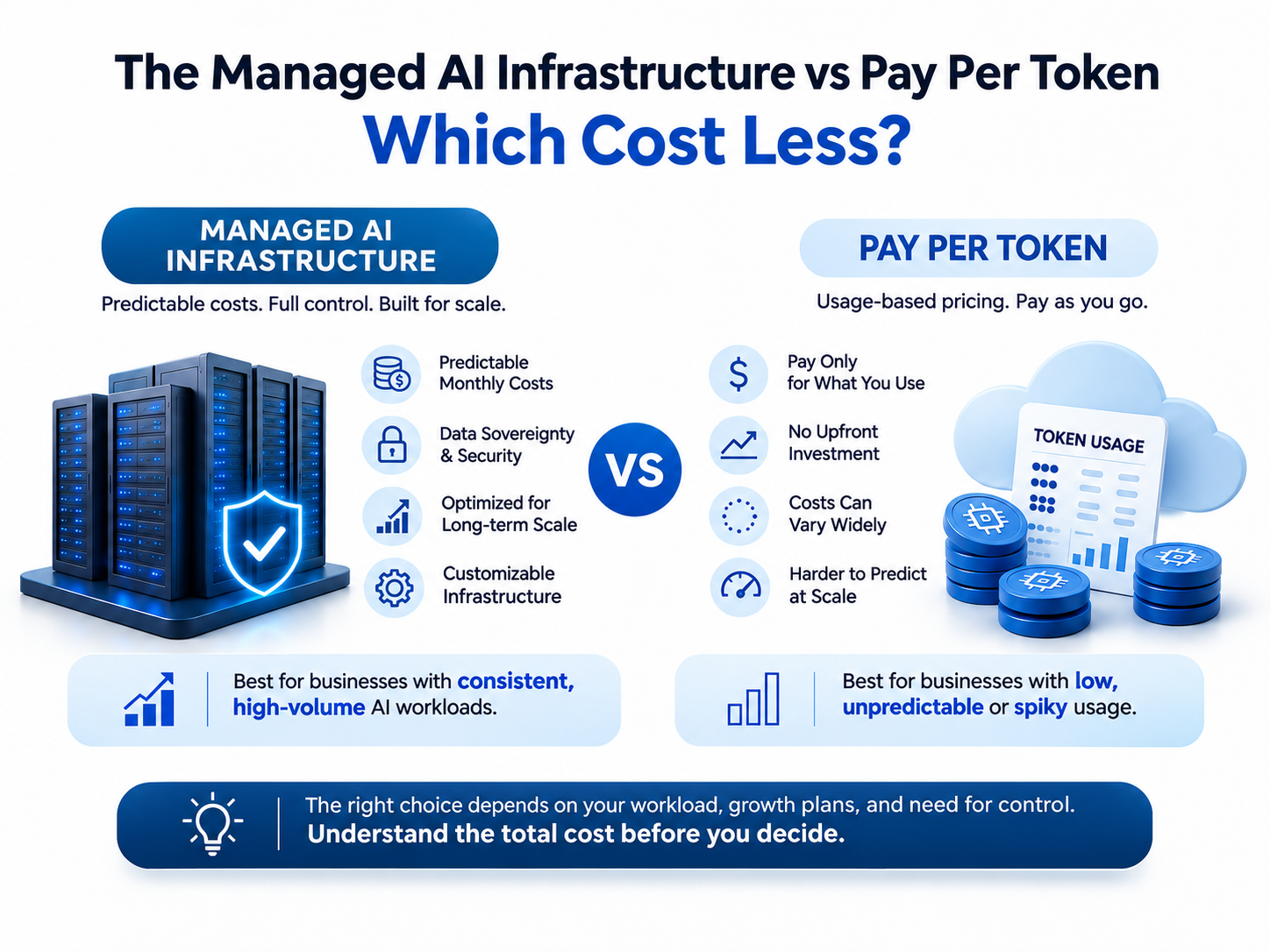
AI Cost Comparison: Managed Infrastructure vs ChatGPT, Claude and Gemini
Most businesses access public AI through two common pricing models: a monthly plan per user or pay per token through an API. Providers such as OpenAI, Anthropic and Google offer these options, but the pricing and cost structure can differ significantly. The right choice depends on how your organisation uses AI, how usage is expected to grow and how predictable you need your costs to be.
- User plans and API pricing are separate. A ChatGPT, Claude or Gemini plan does not include API usage, and API billing does not include access to the consumer or business chat application.
- Monthly plans are broadly similar in price. Individual plans from the major providers are generally around US$20 per month, while business plans can vary by provider and plan.
- The cost model is different. User plans are priced per person, while API costs are based on usage, including the amount of input and output processed.
- Both models use the provider’s platform. For businesses handling sensitive information, the key consideration is not only how much AI costs, but also where data is processed, how it is handled and what level of control the organisation has.
The difference is how the AI is accessed and used. ChatGPT, Claude and Gemini plans are designed for people, giving employees access to the providers’ chat applications. API access is designed for software, allowing businesses to connect AI models to their own applications, workflows and automations. Both can provide access to the same underlying AI models, but API pricing and chat plan pricing work differently.
What ChatGPT, Claude and Gemini Plans Include
ChatGPT, Claude and Gemini plans are generally priced per user, giving employees direct access to each provider’s AI tools. Pricing varies by provider and plan, but the basic pricing structure is similar:
- Individual plans ChatGPT Plus, Claude Pro and Google AI Pro are generally around US$20 (about S$25) per month. Higher tier plans can cost significantly more for users with heavier requirements.
- Team and business plans typically priced per user and may include shared workspaces, administration controls, security features and additional protections for business data.
- Enterprise plans usually custom priced, with features such as single sign-on, compliance options, centralised administration and volume pricing.
The pricing is straightforward: the more people you add, the more you pay. That makes monthly budgeting easier because the cost is tied to headcount rather than every prompt or document processed. The trade-off is that user plans can come with usage limits or fair-use policies. If your team uses AI heavily or you need to connect AI to business applications and automated workflows, the cost model may look quite different from simply buying a seat for each employee.
What API Access Providess
API access is designed for software and business applications, rather than individual users. There are no user seats. Instead, your applications send requests to the AI model and are charged based on the amount of input and output processed. Pricing varies by provider and model, so there is no single token rate across ChatGPT, Claude and Gemini. For many current mid tier models, API pricing is measured in dollars per million input and output tokens, with output tokens generally costing more than input tokens. The main difference is how businesses can use the technology:
- AI within business workflows Applications can use AI to summarise documents, classify support tickets, draft responses, extract information and process data without requiring employees to work through a chat interface.
- No per user licensing A single integration can support multiple teams, applications or customer facing services without buying a separate AI seat for every person.
- Costs follow usage Light usage can remain relatively low, while high volume applications and automated workflows can generate significantly higher monthly API costs.
The key point is that API pricing is usage based. The more your applications process through the model, the more you pay, which makes usage forecasting and workload planning important when estimating the long term cost of AI.
User plans charge by the user, while API pricing follows usage. As your AI adoption grows, understanding which cost model fits your workload becomes increasingly important.
Side by Side: User Plans vs Pay Per Token API
| Seat subscription | Pay-per-token API | |
|---|---|---|
| What you get | Chat applications for employees | AI model access for business systems |
| How it is billed | Per person, per month | Based on tokens processed |
| Typical cost | Around US$20 to US$30 (S$25 to S$38) per person | Varies by model and provider |
| As usage grows | Cost generally stays the same within plan limits | Cost increases as usage increases |
| As headcount grows | Cost increases with each additional user | No additional user seat required |
| Setup required | Generally none for individual use | Technical integration is required |
| Budgeting | Easier to forecast based on headcount | Depends on usage and workload volume |
A Worked Example: Monthly AI Costs for a 20 Person Company
Consider a 20 person company. If everyone uses a business AI plan costing around S$25 to S$30 per user, the monthly cost would be roughly S$500 to S$600, depending on the provider and plan. With API access, the cost works differently. A company may spend a few hundred dollars a month on light automation, while high volume document processing or customer facing AI applications can increase costs significantly as usage grows. There is also a third option: managed private AI infrastructure, where the monthly cost is based on the computing capacity required rather than the number of users or tokens processed.
| Seat subscriptions | Pay-per-token API | Managed Private AI Infrastructure (iWV) | |
|---|---|---|---|
| Monthly cost | ~S$500–760 for 20 users | From a few hundred dollars to S$20,000+ at higher volumes | One fixed monthly fee based on required capacity |
| What drives the bill | Headcount | Usage | Allocated compute capacity |
| If usage doubles | Generally no change within plan limits | Costs can increase with usage | Generally no change within allocated capacity |
| Where data is processed | Provider's platform | Provider's platform | Your private environment |
| Budgeting | Predictable based on headcount | More difficult to forecast | Predictable monthly cost |
Beyond the Price: Where Does Your AI Data Go?
Comparing AI costs is useful, but price does not answer every business requirement. Organisations also need to consider where AI workloads run, how data is processed and who controls the underlying environment. ChatGPT, Claude and Gemini process prompts, documents and generated outputs within their respective provider environments. Business plans can provide additional controls and data protections, but these measures do not necessarily mean that the workload is running within infrastructure controlled by your organisation.
For general business tasks, this may be perfectly suitable. For customer data, financial information, contracts, intellectual property and other sensitive business information, the level of control becomes a more important consideration. A private LLM provides another approach. The AI workload runs within a controlled private environment, while a managed provider handles the infrastructure and operational requirements. This can give businesses greater control over data, access, infrastructure and deployment without requiring them to build and operate the entire environment themselves.
Choosing the Right AI Approach for Your Business
The right approach depends on how your organisation uses AI, the type of data involved and how you want to manage costs.
- User plans are a practical choice when employees need AI for everyday work such as writing, research and analysis.
- API access makes more sense when AI needs to become part of business applications, automated workflows or customer facing services.
- Private LLM infrastructure becomes relevant when data control, security, residency or proprietary information are key requirements, particularly for consistent workloads.
These approaches can also work together. A business might use ChatGPT, Claude or Gemini for general employee productivity, APIs for selected automation and private AI infrastructure for more sensitive workloads.
Frequently asked questions
Is managed AI infrastructure cheaper than ChatGPT, Claude or Gemini?
How much does it cost to run private AI infrastructure?
What is the difference between managed AI infrastructure and ChatGPT, Claude and Gemini?
Is pay-per-token pricing expensive for business AI?
Is buying GPUs better than using managed AI infrastructure?
Ready to build private AI?
Speak with our specialists about the right sovereign AI environment for your data, models and workloads.
Schedule a Consultation